
As an Amazon Associate, we earn from qualifying purchases. This post contains affiliate links – if you buy through them, we may earn a commission at no extra cost to you.
Choosing the best office chair under 300 means balancing support, size, and adjustability without guessing. These picks split on seat material, weight capacity, and lumbar type rather than just brand names. The right choice depends entirely on your body dimensions and how many hours you sit daily.
Best overall: GABRYLLY Ergonomic Office Chair for its four-point support system and three-year warranty coverage. Best for long hours: Ergonomic Molded Foam Chair with four-inch molded foam cushion and five-year warranty. Highest weight capacity: BOLISS Big and Tall Chair supporting four hundred pounds with reinforced metal base.
The rest of this guide breaks down specific needs like air-lumbar systems, cross-legged sitting, and simpler task chairs for shorter sessions.
How We Picked
1. GABRYLLY Ergonomic Office Chair

Best for: Average height users needing full support
This chair provides four distinct supporting points for the head, back, hips, and hands. The mesh seat and back promote airflow during long work sessions lasting four to eight hours. Flip-up arms allow you to push the chair directly under a desk to save floor space when not in use.
The listing specifies a user height range of 5’2″ to 6’1″, making fit predictable before ordering. It includes a three-year warranty and replacement parts support directly from the team. Buyers outside this height range should consult the seller first, as the ergonomic design targets specific body proportions.
Pros
- Four-point ergonomic support system included
- Breathable mesh resists abrasion and transformation
- Three-year warranty covers parts and function issues
- Flip-up arms save valuable desk space
- Seat width accommodates different body builds
Cons
- Height range limited to 5’2″-6’1″
- Assembly requires fifteen to twenty minutes
2. Ergonomic Molded Foam Chair

Best for: Sitters needing pressure relief for eight-plus hours
A four-inch molded foam cushion distributes weight evenly to relieve hip and thigh pressure. The contoured mesh back aligns with the spine while an adjustable lumbar cushion targets lower back relief. This combination addresses comfort specifically for extended workdays exceeding standard shifts.
Flip-up armrests let you tuck the chair neatly under tight desks or shared workspaces. The reinforced metal base supports up to 350 lbs with a five-year warranty for long-term coverage.
Pros
- The thick molded foam seat prevents pressure points
- Five-year warranty ensures coverage for the chair’s frame and mechanisms
- Adjustable lumbar cushion delivers personalized relief
- Reinforced metal base supports 350 lbs safely
- Tilt tension customizes rocking motion easily
Cons
- Lumbar cushion requires manual adjustment
3. Big and Tall Executive Chair

Best for: Users wanting adjustable air-lumbar firmness
An air-adjust lumbar system uses a squeeze-bulb to customize lower back firmness in seconds. This mechanism fills the natural curve of your spine precisely without needing tools or levers. The breathable upholstery features micro-perforations to reduce heat buildup during extended sitting periods.
The seat depth measures 20.66 inches with a waterfall edge to reduce thigh pressure. It supports users up to 6’8″ tall and 300 lbs with memory foam that molds to body curves.
Pros
- Air-lumbar adjusts firmness via squeeze-bulb
- Deep seat fits users up to 6’8″ tall
- Micro-perforations enhance cooling significantly
- Waterfall edge reduces leg numbness effectively
- Memory foam molds to unique body curves
Cons
- Listed for low-pile carpet, so high-pile rugs are left out
4. HUANUO Ergonomic Office Chair with 3D Armrests and Lumbar Support
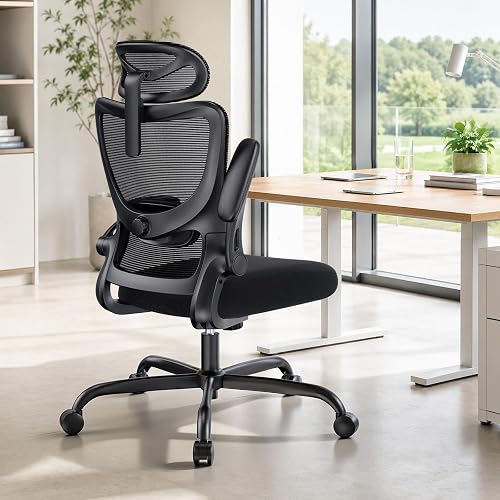
Best for: Typists needing precise arm positioning
Three-dimensional armrests adjust forward, backward, and swivel fifteen degrees for precise elbow support. This range allows alignment with various keyboard heights and desk depths throughout the day. The lumbar support moves independently both vertically and horizontally to match your specific spinal curve.
A 3.14-inch high-density foam seat balances softness with structural support for daily use. The chair holds up to 300 lbs and carries SGS certification for safety and quality assurance. Users who only need basic up-down arm adjustment may find the multi-directional mechanism overly complex.
Pros
- 3D armrests swivel and slide precisely
- Lumbar adjusts vertically and horizontally independently
- SGS certified for trusted safety standards
- Mesh backrest enhances airflow effectively
Cons
- Complex adjustments require initial setup time
5. Marsail Ergonomic Office Chair

Best for: Hot environments requiring maximum airflow
The minimalist mesh backrest molds responsively to your back while promoting maximum airflow. This design prioritizes cooling over plush padding for users in warm climates or stuffy rooms. Adaptable lumbar support adjusts 1.18 inches forward and 2.16 inches up to match body shape.
Rounded PU-padded armrests swivel and flip up ninety degrees for desk clearance or freedom of movement. The 3.14-inch foam seat supports up to 330 lbs with a wider load-bearing area.
Pros
- Mesh maximizes airflow for hot environments
- Lumbar adjusts four ways for custom fit
- Armrests flip up ninety degrees easily
- Wider seat enhances overall support area
- Supports up to 330 lbs durably
Cons
- Headrest adjusts in only two dimensions
6. BOLISS 400lbs Chair Big and Tall Ergonomic Office Desk Chair

Best for: Heavier users needing verified durability
This heavy-duty chair supports up to 400 lbs after rigorous testing for safety and durability. A generously padded streamlined seat cushion uses molded sponge to resist deformation over long periods. The breathable nylon mesh back improves airflow to prevent muggy feelings during hot seasons.
A 3D molded pillow headrest offers four levels of height and angle adjustment to reduce neck strain. The two-year warranty covers replacements except for human damage, providing clear protection terms. Lighter users may find the robust build and wide seat unnecessarily large for their frame.
Pros
- Supports 400 lbs with tested durability
- The dense molded sponge resists collapse
- Headrest adjusts four ways for neck relief
- Nylon mesh prevents heat buildup effectively
- Two-year warranty covers manufacturing defects
Cons
- Wide seat may overwhelm smaller frames
- Lumbar cushion is free-placed not fixed
7. Ergonomic 4-Way Lumbar Chair

Best for: Back pain sufferers needing dual-direction support
Dual-direction adjustable lumbar allows precise customization for lower back fatigue during long sessions. Virgin foam in the seat distributes weight evenly to maintain resilience after eight-plus hours. This focus on targeted spinal alignment distinguishes it from chairs with static back support.
Flip-up armrests enable storage under desks in small home offices or shared workspaces. The reinforced metal base supports 330 lbs and passes multiple stress inspections for reliability. Users without specific lumbar needs may not utilize the dual-adjustment feature fully.
Pros
- Dual-direction lumbar targets lower back precisely
- Virgin foam maintains resilience long-term
- Reinforced metal base passes stress tests
- Flip-up arms fit compact workspaces easily
- Supports 330 lbs with verified inspection
Cons
- Dual lumbar adds adjustment complexity
8. GTPLAYER PU Leather Office Chair
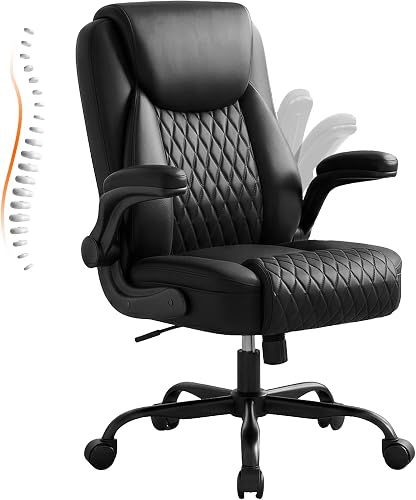
Best for: Traditional aesthetics with modern breathability
Premium PU leather with diamond-stitched breathable panels tackles stuffiness common in traditional leather chairs. The winged mid-back design follows the spine’s natural curve to alleviate pressure during long days. Memory foam cushioning with elastic webbing prevents sinking over years of use.
Padded flip-up arms fold ninety degrees to push the chair flush against desks in compact setups. It supports 300 lbs with BIFMA-certified casters and FSC-certified inner wood components.
Pros
- Breathable PU leather reduces traditional stuffiness
- BIFMA-certified casters ensure rolling safety
- FSC-certified wood supports eco-conscious choice
- Flip-up arms maximize compact workspace utility
Cons
- Leather remains warmer than full mesh
- Assembly takes thirty to forty-five minutes
9. GTPLAYER Cross Legged Office Chair
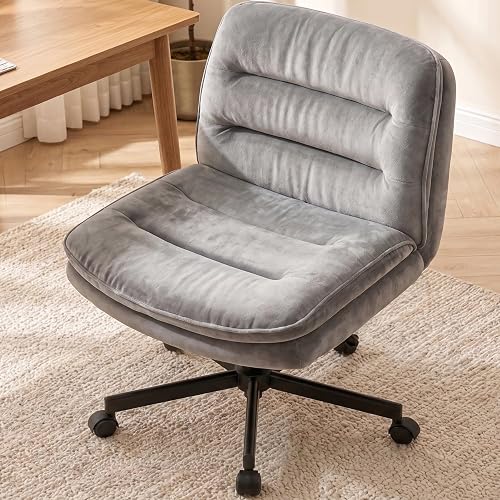
Best for: Flexible sitters changing positions frequently
An extra-wide armless seat allows cross-legged sitting or stretching without restrictive side barriers. This design suits users who shift postures often or prefer non-traditional seating arrangements. High-density cushioning and an ergonomic backrest provide support despite the unconventional shape.
The armless profile tucks completely under desks to save space in bedrooms or cozy corners. A certified gas lift and metal base safely hold up to 300 lbs despite the open design. Users requiring constant arm support for typing will miss the stability of traditional armrests.
Pros
- Wide seat enables cross-legged sitting freely
- Armless design saves maximum desk space
- Certified gas lift ensures safe height adjustment
- Recline feature allows position changes easily
- Simple setup includes all necessary tools
Cons
- No armrests for typing support
10. Amazon Basics Office Task Chair with Adjustable Height
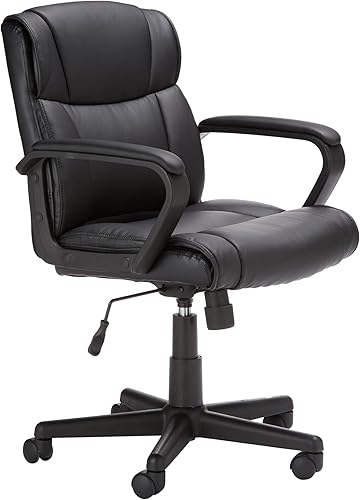
Best for: Short-duration tasks and simple setups
This mid-back task chair offers straightforward height and tilt adjustment without complex mechanisms. Bonded leather upholstery with padded armrests provides basic comfort for conference rooms or occasional use. Compliance with BIFMA safety standards ensures reliable performance for everyday office tasks.
The 275-pound capacity and five-point base suit lighter users or shorter work sessions. Fixed padded armrests limit adjustability but simplify operation for guests or shared spaces.
Pros
- Simple controls suit occasional users perfectly
- BIFMA compliant for verified safety standards
- Padded armrests provide basic resting support
- Compact dimensions fit tight conference rooms
- Bonded leather offers classic professional look
Cons
- Lower weight capacity limits user range
- Fixed armrests lack ergonomic adjustability
How to Choose an Office Chair Under $300
Which seat material actually matters most?
Mesh keeps you cool but feels firmer against the body. Molded foam relieves pressure points. Choose mesh if temperature control is your priority during long shifts. Pick foam if hip pain or pressure sensitivity ends your workday early. The material dictates daily comfort more than any other single feature listed here.
Do I really need adjustable lumbar support?
Fixed lumbar works fine if your spine matches the chair’s preset curve exactly. Adjustable systems matter when you have specific back pain or fall outside average proportions. Air-lumbar and dual-direction options let you fine-tune support as fatigue sets in. Skip the extra adjustment if you’ve never had back issues and fit standard sizing charts comfortably.
What weight capacity should I confirm before ordering?
Always choose a chair rated above your actual body weight for longevity. Listings state capacities ranging from 275 to 400 pounds based on testing standards. Higher ratings indicate stronger bases, cylinders, and frames regardless of your current size. Never assume a chair is sturdy enough without verifying the stated limit in the product specifications.
FelixKing Office Chair offers breathable mesh and flip-up arms similar to top picks. Leather Office Chair targets shorter users specifically with lumbar support but lacked comprehensive dimension data for comparison. Ergonomic Office Chair claims top test rankings but provided insufficient specification details to verify against our selection criteria.
GABRYLLY Ergonomic Office Chair remains the strongest all-around choice for its balanced support and warranty, while Ergonomic Molded Foam Chair best serves those needing pressure relief. Check your exact height and weight against each listing’s stated limits before clicking through to confirm today’s availability. Matching your body to the chair’s specified range matters more than any other factor in this category.
Frequently Asked Questions
What tools do I need for assembly?
Most chairs include all necessary tools and instructions in the box. Assembly typically takes fifteen to forty-five minutes depending on the model’s complexity. Keep the included tools for future tightening, as the listing specifies periodic bolt checks.
How do I maintain the chair long-term?
Wipe mesh and leather surfaces weekly to prevent dust buildup in crevices. Check and tighten all bolts monthly to maintain structural integrity and prevent wobbling. Avoid placing foam seats in direct sunlight to prevent premature degradation. Follow the manufacturer’s specific cleaning guidelines to preserve warranty coverage on materials and mechanisms.
What component fails first typically?
Gas lift cylinders are covered under a shorter warranty period than the frame. Armrest pads and adjustment buttons also show wear before the main frame or base. Mesh fabric generally outlasts bonded leather in high-friction areas. Regular bolt tightening extends the life of moving parts significantly across all models.
Is a basic task chair ever sufficient?
Amazon Basics Task Chair suffices for short sessions under four hours or occasional guest use. It lacks the advanced ergonomics needed for full-time remote work or chronic pain management. Choose it only if your daily sitting time is genuinely limited. Longer durations require the adjustable support found in higher-specification models to prevent discomfort.
Conclusion
Once your new seat arrives, don’t just drop it at your desk and hope for the best. Spend a few minutes tweaking the height and tilt until your feet rest flat on the floor. That small adjustment makes all the difference during long workdays.