
As an Amazon Associate, we earn from qualifying purchases. This post contains affiliate links – if you buy through them, we may earn a commission at no extra cost to you.
Choosing the best office chair under 400 means balancing weight capacity, adjustability, and material comfort without overspending. These ten picks separate themselves by specific strengths: some prioritize heavy-duty frames for larger users, while others focus on precise lumbar tuning or cooling mesh for long shifts. The right choice depends entirely on your body size and daily sitting duration.
Best overall: CAPOT Ergonomic Mesh for its 60-month warranty and micro-adjustable lumbar support system. Best seat comfort: Molded Foam Ergonomic for buyers needing pressure relief via four-inch molded foam cushioning. Highest weight capacity: 700lbs Big and Tall for users requiring a verified seven-hundred-pound structural limit.
Read on if you need specific features like reclining footrests, certified ergonomics, or specialized headrest adjustments.
How We Picked
A product earned a spot only if the seller provided explicit weight capacities, adjustment ranges, or warranty durations in the listing data. We excluded any chair where critical dimensions or support features remained vague or unverified by the manufacturer’s description. This process ensures every recommendation rests on stated facts rather than marketing assumptions.
1. CAPOT Ergonomic Mesh Office Chair
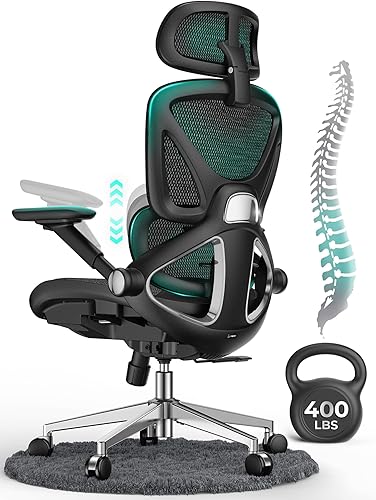
Best for: Long-shift workers needing precise back support
This chair offers two inches of lumbar travel across eight levels, letting you align support exactly with your lower spine. The Aerovith Mesh seat measures 19.3 inches deep to reduce pelvic pressure during extended sitting sessions. A five-year warranty with free part replacements covers the frame and mechanisms against defects.
The flip-up arms and silent PU wheels let you tuck the chair fully under standard desks to save floor space. The chair serves people from 5’5″ to 6’2″. Buyers outside this specific height window should verify fit before ordering.
Pros
- Eight-level adjustable lumbar support system
- Five-year warranty includes free replacement parts
- Flip-up arms maximize under-desk storage space
- BIFMA X5.1 certified structural reliability
- Aerovith mesh reduces pelvic pressure significantly
Cons
- Headrest fits only 5’5″ to 6’2″ users
2. Molded Foam Ergonomic

Best for: Sitters preferring dense foam over mesh
A four-inch molded foam cushion distributes weight evenly to relieve hip and thigh pressure during eight-hour workdays. The contoured mesh back pairs with an adjustable lumbar pad to maintain spinal alignment without trapping heat. Flip-up armrests allow the chair to slide completely beneath most desk surfaces when not in use.
The reinforced metal base supports up to 350 lbs, which is lower than several other options in this article. Users exceeding this weight limit or those who prefer breathable mesh seats will need to look elsewhere. The tilt tension knob lets you customize rocking resistance to match your body weight.
Pros
- Four-inch molded foam relieves hip pressure
- Adjustable lumbar cushion targets lower back pain
- Flip-up armrests enable compact desk storage
- Reinforced metal base ensures lasting stability
- Five-year warranty covers manufacturing defects
Cons
- Weight capacity limited to 350 lbs maximum
3. Big and Tall Office Chair 700lbs with Ergonomic W Wide

Best for: Heavy users needing maximum structural support
This chair supports up to 700 lbs thanks to a silver-plated heavy-duty base and SGS-certified gas cylinder. The W-shaped seat cushion is 5.1 inches thick with twenty-eight built-in spring pockets for sofa-like resilience. Adjustable lumbar panels move forward, backward, up, and down to match your exact sitting position.
The one-year warranty is shorter than competitors offering five years or lifetime coverage. Buyers seeking long-term protection beyond the initial year should factor this into their decision. The 4D padded armrests and 135° rocking system provide flexibility for shifting postures throughout the day.
Pros
- Supports up to 700 lbs safely
- W-shaped cushion with twenty-eight spring pockets
- Lumbar support panels adjust in multiple directions
- SGS-certified multi-stage gas cylinder
- BIFIMA certified for structural reliability
Cons
- One-year warranty is shorter than alternatives
4. Sytas 400lbs Big and Tall Office Chair with Adjustable Headrest

Best for: Users wanting adjustable neck support
The three-level detachable headrest adjusts vertically to prevent neck strain during video calls or reading. Breathable PU leather resists pet scratches and wipes clean easily for low-maintenance upkeep.
Flip-up arms enable the chair to fit under desks in tight home offices or dorm rooms. The 400-lb capacity suits larger users, but those needing mesh breathability should consider other options. Assembly takes approximately twenty minutes with included tools and instructions.
Pros
- Three-level adjustable detachable headrest
- Scratch-resistant PU leather cleans easily
- Flip-up arms suit compact workspaces
- Supports up to 400 lbs reliably
Cons
- Listed for 400 lbs capacity, so users exceeding that weight are left out
5. 4D Flip-up Mesh

Best for: Precise arm and lumbar customization
Armrests adjust in multiple directions including 45-degree rotation to relieve shoulder soreness during typing. The lumbar support travels 2.36 inches across eight positions while the backrest offers nine height settings. An eleven-position headrest detaches without leaving marks, converting the chair from high-back to mid-back configuration.
High-strength mesh promotes airflow to keep you dry during long sessions. The 90°–135° recline locks at three angles with adaptive lumbar tracking. Users who don’t need extensive arm adjustments may find the 4D mechanism unnecessarily complex for basic tasks.
Pros
- 4D armrests rotate forty-five degrees
- Eleven-position removable headrest design
- Eight-position lumbar with 2.36-inch travel
- ANSI/BIFMA X5.1 compliant construction
- Silent casters protect hardwood floors
Cons
- Warranty terms not detailed in listing
6. PU Leather Recliner
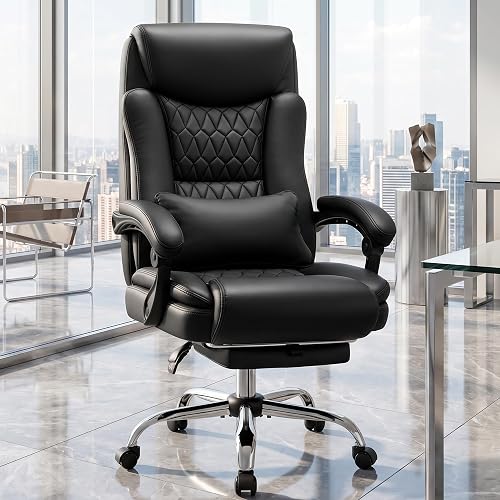
Best for: Reclining comfort with leg support
The retractable footrest extends for full-leg stretching during breaks and tucks away when unused. A split multi-zone seat cushion targets hip pressure points differently than uniform padding designs. The backrest locks anywhere from 90° upright to 160° reclined for napping or relaxed viewing.
Stain-resistant PU leather wipes clean with a damp cloth for easy maintenance. The steel-frame armrests bolt directly to the base to eliminate wobble when sitting or standing. Buyers prioritizing breathability over reclining features should explore mesh alternatives instead.
Pros
- Retractable footrest enables full-leg extension
- Backrest locks from 90° to 160°
- Multi-zone cushion targets hip pressure points
- Bolt-on steel armrests prevent wobbling
- Lifetime after-sales support included
Cons
- PU leather traps heat during long sits
7. GTPLAYER Big and Tall Gaming Chair 400lbs Heavy Duty Office
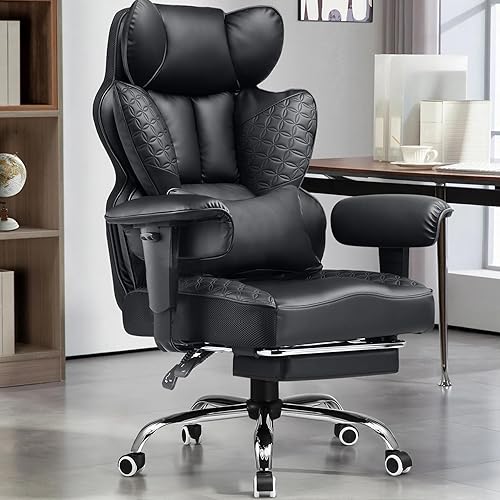
Best for: Gamers needing hybrid work support
Built-in pocket springs in the lumbar zone adapt to spinal curves better than static foam padding. The 3D saddle-shaped seat wraps around legs and buttocks to distribute pressure evenly. Embossed PU leather resists scratches and pilling for durability in active gaming or office environments.
The backrest reclines from 90° to 135° for varied activities throughout the day. A thickened headrest improves neck contact area for taller users. Those preferring traditional office aesthetics over gaming styling may want a different design. Assembly completes in fifteen to thirty minutes with included hardware.
Pros
- Pocket spring lumbar adapts dynamically
- Saddle-shaped seat distributes pressure evenly
- Scratch-resistant embossed PU leather upholstery
- Thickened headrest supports larger contact area
- Metal frame eliminates gradual sinking concerns
Cons
- Gaming aesthetic may not suit formal offices
- Warranty duration unspecified in product data
8. Marsail Ergonomic Office Chair

Best for: Straightforward mesh adjustability
Lumbar support adjusts 2.16 inches vertically and 1.18 inches horizontally to match your spine’s natural curve. The 3.14-inch high-density foam seat provides firm support without excessive sink. Flip-up armrests clear desk edges for storage or closer positioning to work surfaces.
Mesh backrest molds responsively while promoting airflow to prevent overheating. The 330-lb capacity handles most users but falls short of heavy-duty options here. Buyers over this limit or needing deeper recline should check higher-capacity models. Rounded PU-padded armrests swivel and slide for ergonomic positioning.
Pros
- Lumbar adjusts vertically and horizontally
- Flip-up armrests enable under-desk storage
- Responsive mesh promotes continuous airflow
- 3.14-inch foam balances firmness and comfort
- Simple assembly with clear instructions
Cons
- Weight capacity capped at 330 lbs
- Recline limited to 120 degrees maximum
9. ELABEST X100 Ergonomic Mesh Office Chair with Footrest

Best for: Feature-rich all-day versatility
Dynamic 3D lumbar uses force-sensitive springs to track spinal movement automatically as you shift positions. The extendable footrest adjusts to two angles for seamless transitions between focused work and rest. 5D flip-up armrests with dense EVA foam padding reduce contact pressure on forearms.
Dual-stripe AirMesh claims improved airflow and elasticity over standard weaves for sustained comfort. The 300-lb capacity is lower than similarly featured big-and-tall chairs in this list. Users exceeding this limit need a higher-rated frame despite the advanced adjustability. Orthopedic collaboration informed the seventeen-point micro-adjustment system.
Pros
- Force-sensitive lumbar tracks spine dynamically
- Extendable footrest with dual-angle adjustment
- 5D armrests with dense EVA foam padding
- Seventeen-point micro-adjustment system
- BIFMA-certified structure ensures safety
Cons
- Weight capacity limited to 300 lbs
10. BIFMA Mesh Chair

Best for: Certified ergonomic compliance
BIFMA X5.1 certification verifies this chair meets rigorous safety and durability standards for office seating. Adjustable lumbar moves in multiple directions to deliver tailored lower back support. The 3D armrests reduce shoulder strain by allowing personalized positioning for various desk heights and tasks.
Breathable high-elastic mesh prevents stuffiness during extended use periods. Seat dimensions are explicitly listed (19.8″ wide, 18.9″ deep) for confident sizing decisions. Buyers needing weight capacities above standard ratings should verify suitability first. Note that the base leg ships inside the seat package during assembly.
Pros
- BIFMA X5.1 certified for safety
- Multi-directional adjustable lumbar support
- Explicit seat dimensions aid sizing decisions
- High-elastic mesh prevents heat buildup
- Multi-position recline from 90° to 120°
Cons
- Weight capacity not stated in listing
- Base leg packed inside seat assembly
How to Choose an Office Chair Under 400
Which weight capacity do I actually need?
Match the chair’s rated capacity to your body weight plus a safety margin for dynamic movement. Chairs rated at 400 lbs or higher use reinforced bases and certified gas lifts that resist gradual sinking over years of daily use. If you’re near a listed limit, choose the next tier up; operating at maximum capacity accelerates wear on cylinders and casters regardless of build quality.
Should I pick mesh or foam seating?
Mesh excels at temperature regulation for warm environments or sitters who run hot during long shifts. Molded foam provides superior pressure distribution for hip and thigh comfort but may retain heat without adequate ventilation. Your climate, clothing choices, and sensitivity to pressure points matter more than material superiority; neither option universally outperforms the other across all use cases.
What warranty length signals real durability?
Five-year warranties covering free part replacements indicate manufacturer confidence in long-term component survival. Lifetime support claims require verifying what “support” actually includes—replacement parts, labor, or merely troubleshooting advice. Always confirm warranty terms cover the specific components most likely to fail: gas lifts, casters, and tilt mechanisms.
TRALT Office Chair, FelixKing Office Chair, and Big Tall Office Chair also appeared in our search but lacked sufficient specification detail or warranty clarity to earn top placement alongside these ten picks.
The CAPOT Ergonomic Mesh stands out for comprehensive adjustability and warranty coverage, while the Molded Foam Ergonomic serves those prioritizing cushioned pressure relief. Check your desk height and available floor space next to ensure your chosen model fits your physical workspace before ordering.
Related guides
- How to Cover a Club Chair: Step-by-Step DIY Guide
- How to Pose on a Chair: 7 Pro Tips for Dynamic Angles
- How to Pose in a Chair for Natural and Confident Photos
Frequently Asked Questions
What desk heights work with these chairs?
Most chairs here adjust between 18.5 and 23.3 inches at the seat, fitting standard 28-30 inch desks. Measure your desk’s underside clearance if using flip-up arms, as some mechanisms require extra vertical space to fold completely. Gas lift swaps are sometimes available from manufacturers for non-standard desk heights, but confirm compatibility before purchasing aftermarket cylinders.
What component fails first typically?
Gas cylinders lose pressure gradually before failing catastrophically, causing slow sinking rather than sudden drops. Caster wheels develop flat spots or bearing noise after years of rolling over thresholds and debris. Tilt mechanism springs weaken with heavy reclining use, reducing tension control effectiveness. Regular inspection catches these issues early; most manufacturers provide replacement parts under warranty before complete failure occurs.
Is a basic mesh chair enough for daily use?
Basic mesh chairs with fixed lumbar and simple tilt suffice for users under six hours daily without existing back issues. Extended shifts or chronic discomfort justify investing in multi-axis lumbar adjustment and higher-density cushioning. Your current pain levels and sitting duration determine adequacy more than feature counts; a simpler chair meeting your actual needs outperforms an adjustable one you’ll never fine-tune properly.
Conclusion
Your comfort matters most, so don’t rush this decision. Measure your desk height and test a few options if you can. You’ll feel the difference when your back isn’t aching after hours of work. Trust your body’s feedback to find the seat that truly fits your daily routine.