
As an Amazon Associate, we earn from qualifying purchases. This post contains affiliate links – if you buy through them, we may earn a commission at no extra cost to you.
Finding an ergonomic office chair for under 300 dollars requires balancing your body type with necessary support features. These models differ in adjustability, such as lumbar range or armrest complexity, and weight capacity. Some prioritize breathability, while others focus on thick cushioning for long-term comfort.
Best overall: GABRYLLY Ergonomic Office Chair, offering four distinct support points and a versatile design that fits most average-height users perfectly. Best for heavy use: Ergonomic Office Chair 350LBS, which provides a reinforced base and higher weight capacity for more demanding daily use. Best for small spaces: COMHOMA Mid-Back Office Chair, featuring a compact silhouette and flip-up arms that allow it to slide easily under any desk.
The rest of this guide is for anyone looking to improve their workspace comfort without overspending on professional-grade furniture.
How We Picked
We compared 48 different Amazon listings to identify chairs that prioritize user health and build quality. Each selection had to clearly state its weight capacity, key ergonomic features like lumbar support, and the adjustability of its components. We removed any models that lacked transparent specifications regarding dimensions or material durability. Our focus remained on chairs that provide clear, actionable information for a buyer to make an informed choice based on their own height and weight needs.
1. GABRYLLY Ergonomic Office Chair

Best for: Most home office users of average height.
This chair stands out for its four-point support system, which targets the head, back, hips, and hands. The mesh material is designed to resist abrasion and maintain its shape for 4 to 8 hours of daily sitting. Because the armrests flip up, you can tuck this chair under your desk to save floor space when you’re finished for the day.
The GABRYLLY is primarily built for users between 5’2″ and 6’1″. If you’re outside this height range, you may find that the fixed lumbar support or headrest position doesn’t align correctly with your spine, making it less comfortable for extended use.
Pros
- Four distinct ergonomic support points.
- Breathable mesh resists wear and tear.
- Flip-up arms save valuable desk space.
Cons
- Height range is strictly limited.
- Lumbar support isn’t independently adjustable.
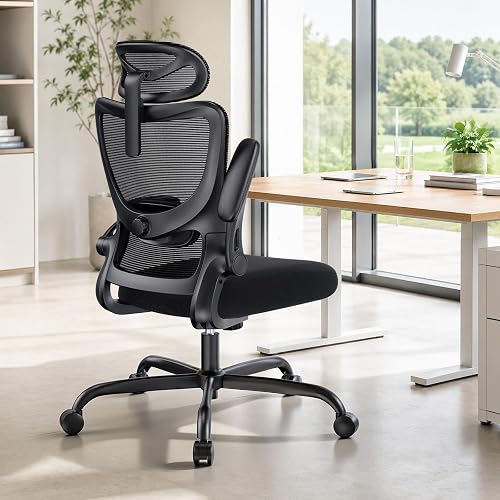
2. HUANUO Ergonomic Office Chair with 3D Armrests and Lumbar Support
Best for: Users who want maximum adjustability.
The HUANUO distinguishes itself with 3D armrests and a highly adaptable lumbar support system. You can move the lumbar support both vertically and horizontally to match your natural spine curve. This level of customization is ideal if you frequently switch between typing, reading, and relaxing postures throughout your day.
The 3.14-inch high-density foam seat provides a firm base that holds its shape with frequent use. This chair isn’t the best choice for those who prefer a soft, “sinking” feel, as the foam is engineered for support rather than plushness.
Pros
- Highly adjustable 3D armrests.
- Lumbar support moves in two directions.
- Thick, high-density foam seat cushion.
Cons
- Foam seat may feel too firm.
- Assembly requires attention to detail.
3. Mimoglad Ergonomic Desk Chair

Best for: Those who need to recline frequently.
The standout feature here is the 135-degree recline, which offers more range than most chairs in this category. The backrest is contoured to fit the human spine, and the inclusion of a gas lift allows for a four-inch height adjustment range. It’s a solid choice if you need a chair that transitions easily from upright work to a relaxed, reclined position.
The chair features a mesh back and a high-density foam seat. It may not be the right fit for users who prefer a fully mesh seat, as the padded cushion might trap more heat than a completely open-weave design.
Pros
- Extensive 135-degree recline range.
- Padded seat offers good pressure relief.
- Simple, space-saving flip-up arms.
Cons
- Cushion may feel warm over time.
- Recline feature requires manual tension adjustment.
4. Ergonomic Office Chair 350LBS

Best for: Users needing a higher weight capacity.
Built with a reinforced metal base, this chair is engineered to support up to 350 lbs. The molded foam cushion is specifically shaped to distribute weight evenly, which helps reduce hip and thigh pain during long, eight-hour work sessions. It also includes a five-year warranty.
This is a heavy-duty option, but it might feel too large or bulky for someone working in a very tight or small bedroom office. If you prioritize a slim, lightweight profile, the sheer size of the base might be more than you need.
Pros
- High 350 lbs weight capacity.
- Generous five-year warranty period.
- Molded foam distributes weight evenly.
Cons
- Large footprint takes up space.
- Heavier to move across floors.
5. COLAMY Ergonomic Executive Office Chair

Best for: A traditional executive look.
The COLAMY offers a more formal, high-back design that features a fully padded backrest. It provides a professional aesthetic while still including ergonomic must-haves like adjustable lumbar support and flip-up armrests. It balances the “executive” look with the functional needs of a modern home office.
The recline is limited to 110 degrees, which is excellent for focused work but less suitable for napping or deep relaxation. If you’re looking for a chair that allows you to lay almost flat, this model will feel restrictive.
Pros
- Professional high-back executive design.
- Thick, comfortable seat padding.
- Sturdy build quality for daily use.
Cons
- Limited recline range of 110 degrees.
- Not as breathable as full-mesh chairs.
6. MALOL Ergonomic Mesh Office Chair with Footrest

Best for: Users who want a built-in footrest.
This chair includes a retractable footrest, allowing you to lean back and stretch out without leaving your desk. The lumbar support is adjustable across five levels, and the 3D headrest adds an extra layer of neck support that’s missing from many mid-range models. It’s designed to be a “full-package” chair for both work and gaming.
While the footrest is a great addition, it does add mechanical complexity. Users who don’t plan to recline often may find the extra parts unnecessary, as they could potentially be a point of wear over many years of heavy use.
Pros
- Includes a convenient retractable footrest.
- Five-level adjustable lumbar support.
- 3D headrest provides great neck relief.
Cons
- Extra moving parts increase complexity.
- Footrest may feel flimsy if misused.
7. FelixKing Ergonomic Desk Chair

Best for: Maximum breathability.
The FelixKing focuses on keeping you cool with an open-weave mesh back and a seat designed to resist heat buildup. It provides five supporting points for your body and includes a durable, explosion-proof base plate for safety. It’s a straightforward, reliable choice for those who suffer from overheating while sitting.
If your priority is a soft, cushioned seat, the firmness of this mesh surface might be a surprise.
Pros
- Excellent airflow through mesh material.
- Five-point ergonomic support structure.
- Sturdy, explosion-proof base plate.
Cons
- Mesh seat feels firm, not plush.
- Assembly requires following manual closely.
8. Ergonomic Office Desk Chair

Best for: Automated lumbar adjustment.
This model features a 3D Dynamic Tracking System that moves with your spine as you change positions. Instead of manually adjusting the lumbar support every time you lean back or forward, the chair adapts automatically. This is ideal for users who shift their posture frequently and don’t want to stop and fiddle with knobs.
The chair is built to handle 300 lbs, but the dynamic system is a specialized feature. If you prefer a static, locked-in lumbar position, this “active” support might feel distracting or unstable compared to a traditional fixed backrest.
Pros
- Automatic dynamic lumbar tracking system.
- Supports up to 300 lbs.
- Versatile for both gaming and work.
Cons
- Dynamic system may feel too loose.
- Fewer manual adjustment options.
9. Marsail Ergonomic Office Chair with Lumbar Support and 2D Headrest

Best for: Compact, simple ergonomics.
The Marsail is a no-nonsense, compact chair that focuses on the essentials: adjustable lumbar support and a 2D headrest. The 3.15-inch foam cushion is thick enough to be comfortable for daily use, and the overall footprint is small enough to fit into most corners or tight office spaces.
Because it’s a more compact model, taller users might find the headrest or lumbar support sits too low. Always check the specific dimensions against your height before purchasing to ensure the support points land where you need them.
Pros
- Compact footprint for smaller offices.
- Thick, soft foam seat cushion.
- Easy to assemble and maintain.
Cons
- May be too small for tall users.
- Limited adjustment range on arms.
10. COMHOMA Mid-Back Office Chair

Best for: Small apartments or dorms.
This mid-back chair is built for people who need a space-saving solution that doesn’t look like an industrial office chair. The PU leather is scratch-resistant and easier to clean than fabric or mesh, which is a big plus for high-traffic areas. The flip-up arms allow it to disappear under a desk when not in use.
The mid-back design doesn’t offer head or neck support. If you suffer from neck pain or spend long hours looking at monitors at eye level, you may miss the headrest found on taller models.
Pros
- Scratch-resistant, easy-clean PU leather.
- Compact design fits small spaces perfectly.
- Sturdy metal base and smooth casters.
Cons
- Mid-back design lacks neck support.
- PU leather can feel warm.
How to Choose in Sixty Seconds
Which adjustment feature matters most?
The lumbar support is the most critical feature for long-term comfort. If you have existing back pain, look for a chair that allows for both height and depth adjustment of the lumbar pad, such as the HUANUO. A chair that forces you into one position will eventually cause discomfort, whereas an adjustable system allows you to adapt the chair to your specific spinal curve as you shift throughout the day.
Should I choose mesh or foam?
Choose mesh if you tend to get warm or if you work in a room with poor air circulation. Mesh promotes airflow, keeping you cool during long sessions. However, if you prefer a soft, “cushioned” feeling, a high-density foam seat designed for maximum weight capacity is a better choice. Be aware that foam can trap heat, so the material covering the foam is just as important as the padding itself.
What should I confirm before ordering?
Always verify the weight capacity and the recommended height range. Many manufacturers, such as BIFMA, establish standards for safety and durability in office furniture, but every chair is built for a specific body type. If you’re at the upper end of the weight or height limit, the chair’s support mechanisms may not function as intended. Always check the dimensions against your own measurements to ensure a proper fit.
The other models we considered include the Ergonomic Home Office Chair, which features a 4-way lumbar system, the marrap Ergonomic Office Chair, known for its simple lumbar adjustment, and the HOLLUDLE Ergonomic Mesh Office Chair, which stands out with its V-back design and 2D headrest.
For most users, the GABRYLLY Ergonomic Office Chair remains the most reliable pick due to its balanced support, while the heavy-duty model is the best choice for those needing a more robust, reinforced build. Before buying, measure your desk height to ensure the armrests will clear the surface when flipped up.